
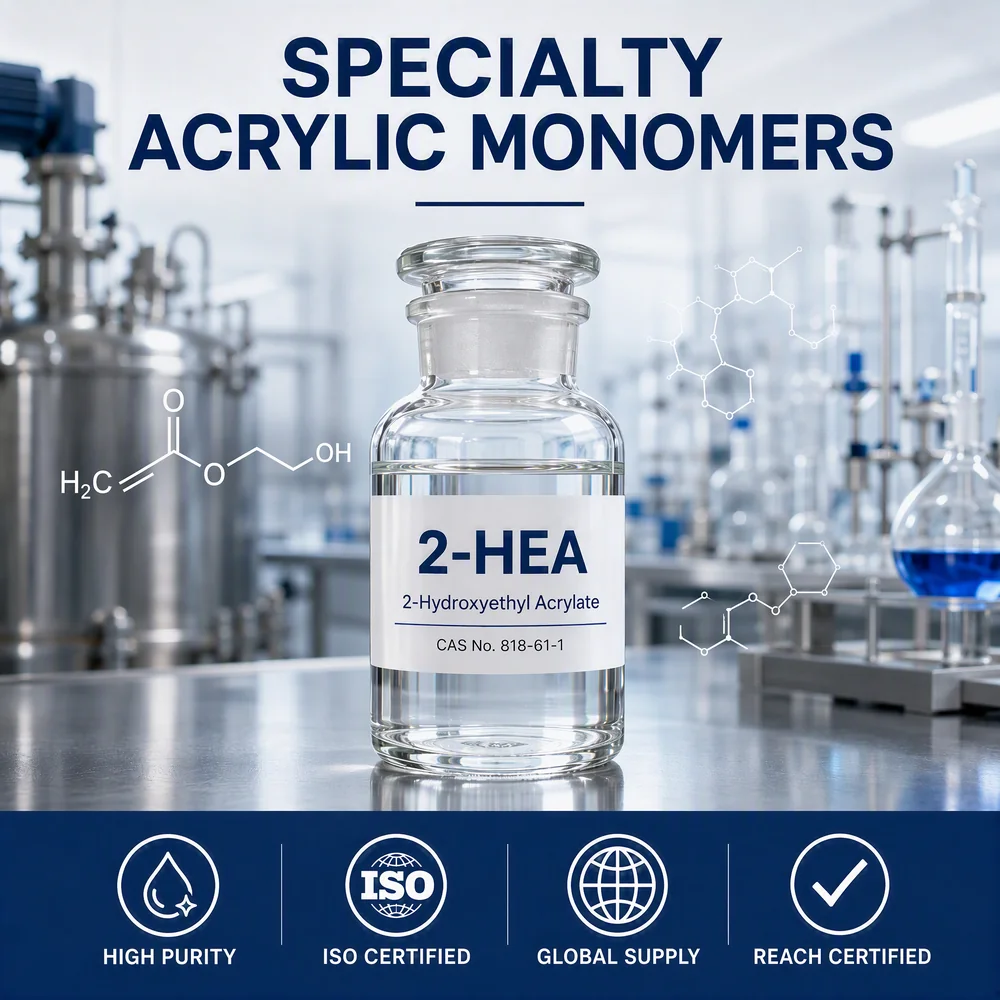
2-Hydroxyethyl Acrylate (2-HEA) — CAS 818-61-1
2-Hydroxyethyl Acrylate (2-HEA) is a high-purity hydroxy-functional acrylic monomer containing reactive hydroxyl groups and acrylate double bonds. It is widely used as a key building block for the synthesis of acrylic resins, polyurethane systems, UV-curable coatings, adhesives, and specialty polymer materials.
With excellent polymerization reactivity, good compatibility, and stable quality performance, DECHEM 2-HEA provides reliable raw material solutions for global coatings, adhesives, and polymer industries.
Technical Data Sheet (TDS)
Safety Data Sheet (SDS)
Sample Certificate of Analysis (COA)
Request Documents
This document is not published yet. Please request it and our team will provide the latest version.
Request DocumentsTechnical Specifications
| Parameter | Value | Method |
|---|---|---|
| Purity (monoester) | ≥ 97.0% (93% grade also available) | GC |
| Hydroxyl Value | Approx. 430–500 mg KOH/g | Titration |
| Acid Value | ≤ 1.0 mg KOH/g | Titration |
| Water Content | ≤ 0.10% | Karl Fischer |
| Color | ≤ 30 APHA | Visual |
| Inhibitor (MEHQ) | 200–400 ppm | HPLC |
| Viscosity (25°C) | Approx. 5–15 mPa·s | Viscometer |
| Density (20°C) | Approx. 1.10 g/cm³ | ASTM D4052 |
Key Features
- High purity and consistent quality
- Excellent polymerization reactivity
- Hydroxyl functional monomer for crosslinking modification
- Good compatibility with acrylic and polyurethane systems
- Stable production capacity and global supply capability
- Suitable for industrial and specialty applications
Applications
UV / EB Curing Coatings
Used as a reactive monomer to improve coating hardness, adhesion, flexibility, and crosslinking performance.
Acrylic Resins
Provides hydroxyl functionality for resin modification and enhances chemical resistance and durability.
Industrial Coatings
Applied in automotive coatings, protective coatings, and high-performance surface coatings.
Adhesives & Sealants
Improves bonding strength, flexibility, and crosslinking performance in adhesive formulations.
Polymer Modification
Introduces hydroxyl functionality into functional polymers, copolymers and surface modification materials.
Packaging & Supply
| Packaging | Capacity | Use |
|---|---|---|
| Standard Steel / HDPE Drums | 200 kg net | LCL & FCL container shipments |
| IBC Totes | 1,000 kg net | Standard industrial users with liquid dosing |
| Bulk ISO Tank | 20,000–24,000 kg | Bulk delivery for large industrial buyers |
Storage & Safety
| Item | Requirement |
|---|---|
| Storage Temperature | 15–25°C (avoid exceeding 35°C) |
| Inhibitor Maintenance | Requires dissolved air/oxygen; do not store under inert gas atmosphere |
| Container Material | Original HDPE containers or stainless steel tanks with air blanket |
| Shelf Life | 12 months from manufacturing date in unopened original containers |
FAQ
What is 2-Hydroxyethyl Acrylate (2-HEA) and what are its primary industrial uses?
2-Hydroxyethyl Acrylate (CAS 818-61-1) is a functional acrylic monomer featuring an active hydroxyl group and an acrylate double bond. It is primarily used in UV-curable coatings, inks, pressure-sensitive adhesives, automotive acrylic resins, and industrial coatings to enhance adhesion, curing speed, and chemical resistance.
How does 2-HEA differ from HEMA?
While both are hydroxyl-functional monomers, 2-HEA contains an acrylate group, giving it faster polymerisation reactivity and higher flexibility compared to HEMA, which contains a methacrylate group with a methyl side chain providing higher hardness and glass transition temperature (Tg).
What packaging options do you offer for bulk export of 2-HEA?
We supply 2-HEA in 200 kg plastic/steel drums, 1,000 kg IBC totes, and ISO tank bulk shipments (approx. 20–24 MT). All containers are compliant with UN transport standards for hazardous chemical export.
What is the standard MOQ and lead time?
Standard MOQ is 1 drum (200 kg) for sample evaluations, while FCL orders (16 MT per 20' FCL) are standard for commercial exports. Production and dispatch lead time is typically 7 to 14 days upon order confirmation.
What safety precautions should be taken when handling 2-HEA?
2-HEA is toxic by dermal absorption and ingestion, and causes severe skin and eye irritation/burns. Always handle in well-ventilated areas using appropriate protective equipment (goggles, full face shield, nitrile gloves, apron). Consult the SDS for detailed emergency protocols.